Sunday, June 19, 2011

"On Being Apparent"


“The universe is composed of subjects to be communed with, not objects to be exploited. Everything has its own voice. Thunder and lightning and stars and planets, flowers, birds, animals, trees—all these have voices, and they constitute a community of existence that is profoundly related.”

Thomas Berry
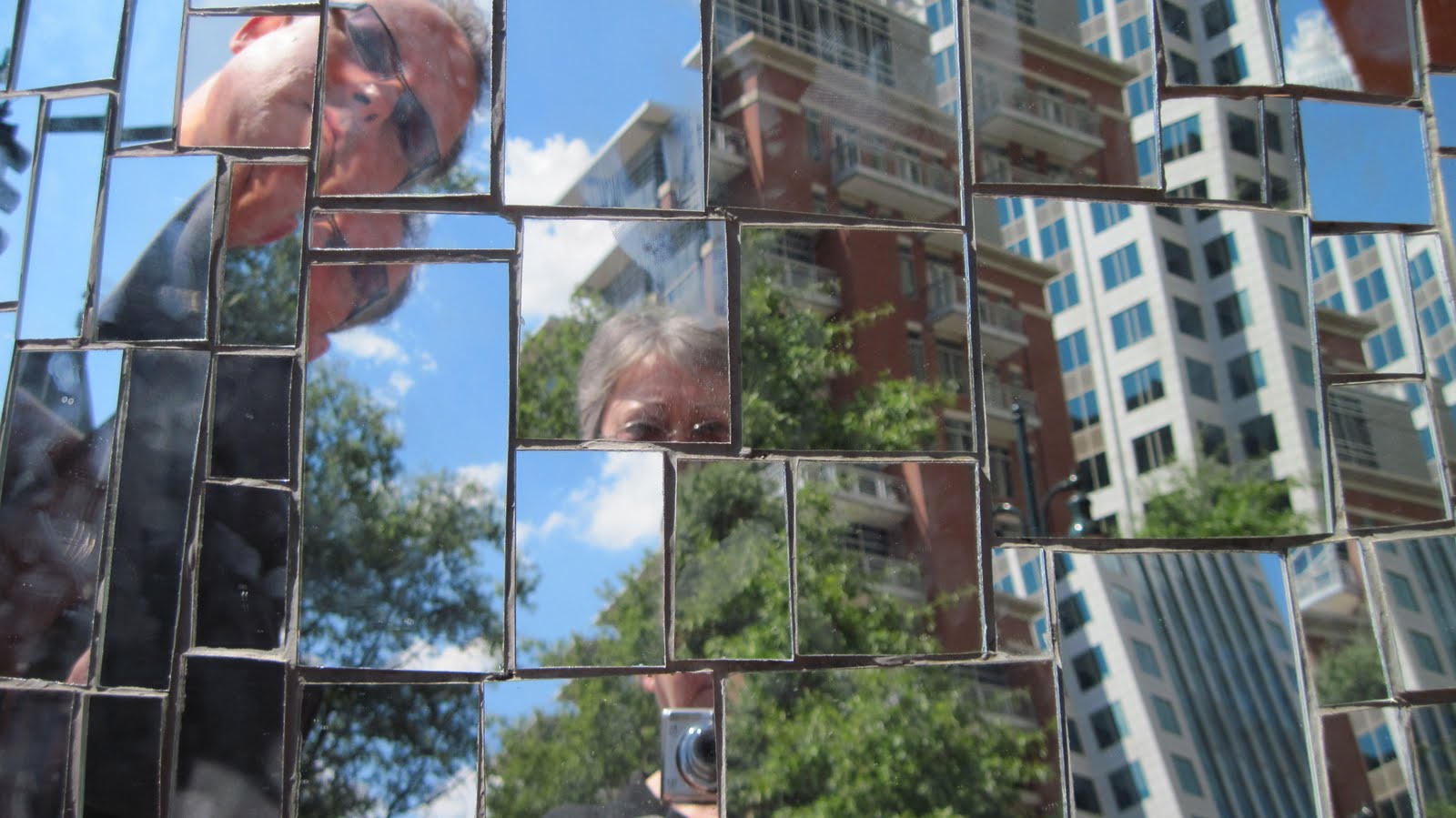
Theodor Adorno said that, "we only know ourselves by knowing our fractured selves." Or something like that. I could look it up. So could you. And yeah, I agree with the sentiment in that each fracture is like an emotional growth ring on a tree - signifying a break, a loss, a cut, an exchange. I realized this one day when I told a friend that I would never get a tattoo. She tenderly took my hands and studied the scars and the callouses and wrinkles and declared, "Darling, you've been giving yourself tattoos for years."

Mary Geitner, Ben Ford, Phoebe Ford, Willoree Ford

Lately, I've been giving more thought and directed attention to my integrated self (such as it is). I have always maintained you know, divisions in my life. As if I were a discount store with a variety of departments. This included my work, my real work, my work for money. My relaxed time, my stressed time, my no time, my time in a bottle. And my rolls and assignments? Rows 12 through like, a billion. Artist, father, husband, son, brother, friend. Builder, teacher, student. Story teller, bad joke teller, William Teller. The aisles were wide, for the most part. Uh-Oh. Clean up on aisle 57.

Robert Walker Geitner III, "Self Portrait with Micky"

But all those shelves (while particularly handy for storing all the accumulated bric-a-brac of an inquisitive life) end up being divisive, casting shadows on shadows and aspersions on rugs.

And so I am in the process of becoming my synthetic self. Working out of and recognizing, that creativity is a series of overlapping interludes. To even attempt to understand how this might evolve would be to encapsulate the very activity of synthesizing into a tangible bauble of a thought. A synapse fossilized in amber. It might give me something to hold up to the light, but with most of the shelves gone, where would I store that thought? Besides, understanding is beginning to seem so very inadequate. What I am curious about is beyond understanding.

Tom Schulz using tools inappropriately in the Spidey-Hole.

Being a father is such a necessary and critical format of being for me. Being a father consistently requires that I upgrade my contract with Understanding. Being a father is not so much challenging to me it is a direct challenge to me. Especially now that the kids are grown up and spread far afield, especially as they create their own unique and complex realities, and especially as they deign to allow my reality to intersect with theirs in spiraling patterns of overlapping aspirations.

Sometimes, when I step beyond my clever self, I am able to access my innate wisdom. You know what I'm talking about. You do that. You might call it clarity. Or perhaps maturity. I just know that in those moments, understanding is not required because you. I. We. Are literally drowning in knowledge. Like that Peace that passeth all understanding thing. In these moments, I know that I called out to my kids and they responded. And they called out to me and I responded. Still do. And even when we aren't acknowledging it, my kids and I are calling out to you. And you are responding. And you are calling out to us and we are responding.
And that is so very powerful. And that type of power never, no never. Sits on no shelf.


Empathinc. was registered as a domain at 8:00 AM, September 11, 2001. It is an artist's ongoing investigation into how we occupy space, embody our own stories, and develop synthetic strategies of fair exchange. All artwork and writing by Tom Schulz, unless otherwise noted.


Thursday, May 26, 2011

"The God and The Universe Conversations". Week Twenty Four.

"HOW YOUR STORY COMPLETES OUR STORY:
To Cynthia Underwood"


empathinc.: our story would be incomplete without your story.
Monday at 11:45pm · LikeUnlike ·
2 people like this.

Cynthia Underwood: One of these days I'm gonna look into your story.
Monday at 11:53pm · LikeUnlike

empathinc.: and you will see a reflection of yours, Cynthia.
Tuesday at 12:10am · LikeUnlike

Cynthia Underwood: More info please.
Tuesday at 12:13am · LikeUnlike

empathinc.: Ok. but I have to ponder a bit.
Tuesday at 12:16am · LikeUnlike

Cynthia Underwood: I'll be waiting.
Tuesday at 12:20am · Like


“The dimension of the divine opens forth from the human face.”
Emmanual Levinas, Totality and Infinity


"Humanomaly"© 2002
Watercolor on Paper
From the "Commanomaly© Series"


"For Levinas, coming face to face with the Other is a non-symmetrical relationship. I am responsible for the Other without knowing that the Other will reciprocate. Whether or not Others reciprocate is their affair not mine. Thus, according to Levinas, I am subject to the Other without knowing how it will come out. In this relationship, Levinas finds the meaning of being human and of being concerned with justice......I am intrigued with the simplicity of Levinas’ idea that in the human face is found the original ethical code. From a look into the face of the Other we become aware of basic human responsibility and meaning. Levinas is critical of a society in which people are depersonalized, in which they move around side by side rather than meet face to face. "
From: Face to Face
by Elder Lindahl (read entire article hear)


"Investigative Reporter"© 2004
Watercolor on Paper
From the "My Nature Series"


Yeah, well all this face time is cool and all, but I'm talking about story here. We share our stories. That we feel more fulfilled in the writing of them is another concern. We speak. Our faces contort, our muscles strain. Air passes over our larynx and produces modulated sound. Sound that has some sort of codified meaning. Our face and our story are indivisible. As I recognize my responsibility in recognizing your face, so I recognize the profound impact (on my story) of your story. If this implies that I cannot kill you, please don't confine that to physicality. There are many ways to die. Many ways to kill. An essential conceptual murder is in silencing. Turning a deaf ear to your story. Thinking of responses even as you are sharing your dialogue. Listening is great. Taking in an Other's story is a gift to both parties. This gift (enacted) is the God and The Universe conversation.


Women In Art from Philip Scott Johnson on Vimeo.


“Somehow our devils are never quite what we expect

when we meet them face to face."

Nelson DeMille


This concludes Week Twenty Four of

"The God and The Universe Conversations".


All art and writing by Tom Schulz unless otherwise noted, or unless it is so cool
he will try to get away with claiming it as his own."The God and The Universe Conversations" are based on Tom's protracted reading of Process and Reality, by Alfred North Whitehead.

Saturday, May 21, 2011

"The God and The Universe Conversations". Week Twenty Three.


"The Sacrifice of Isaac"
CONCLUSION


Ideas are more powerful than guns.
We would not let our enemies have guns,
why should we let them have ideas?

Joseph Stalin


"There is the Would"© 2004
Watercolor and Gesso on Paper


and I will make your offspring as numerous as the stars of heaven and as the sand that is on the seashore. And your offspring shall possess the gate of their enemies, 18and by your offspring shall all the nations of the earth gain blessing for themselves, because you have obeyed my voice.’
Genesis 22, The New Revised Standard Version, copyright 1989


"Know We Have Them on the Run"© 2004
Watercolor and Gesso on Paper

From the Editor: So here we are. Our Hero has passed the test. The dogs have been called off, and now it is time for the bestowing of the treasure. Because isn't that what sacrifice is about? You exhibit your willingness to give up something.....let's even say something big. And in return? A little acknowledgement would be nice. But Abraham gets that and wins the bonus round! He will be the beginning of an entire peoples. Constellations and galaxies of beings. And that which might deny him access? The gates of his enemies? The gates of his enemies will not prevail, and he will be blessed because he obeyed without question.

Well, today (in this moment), I am going to accept Abraham's blessing. I am going to have as many creative ideas as there are stars and I am going to share them with God. I am going to be involved in as many positive interactions as there are grains of sand at the beach and God will think that is cool. I am going to recognize the impediments to being my authentic self and saunter through those gates that I have constructed. I will listen to the words of Lao Tzu, "Man's enemies are not demons, but human beings like himself." And the results of my involvement will continue to fascinate and encourage me, for I would have participated fully.

I will draw nearer. That's my plan.


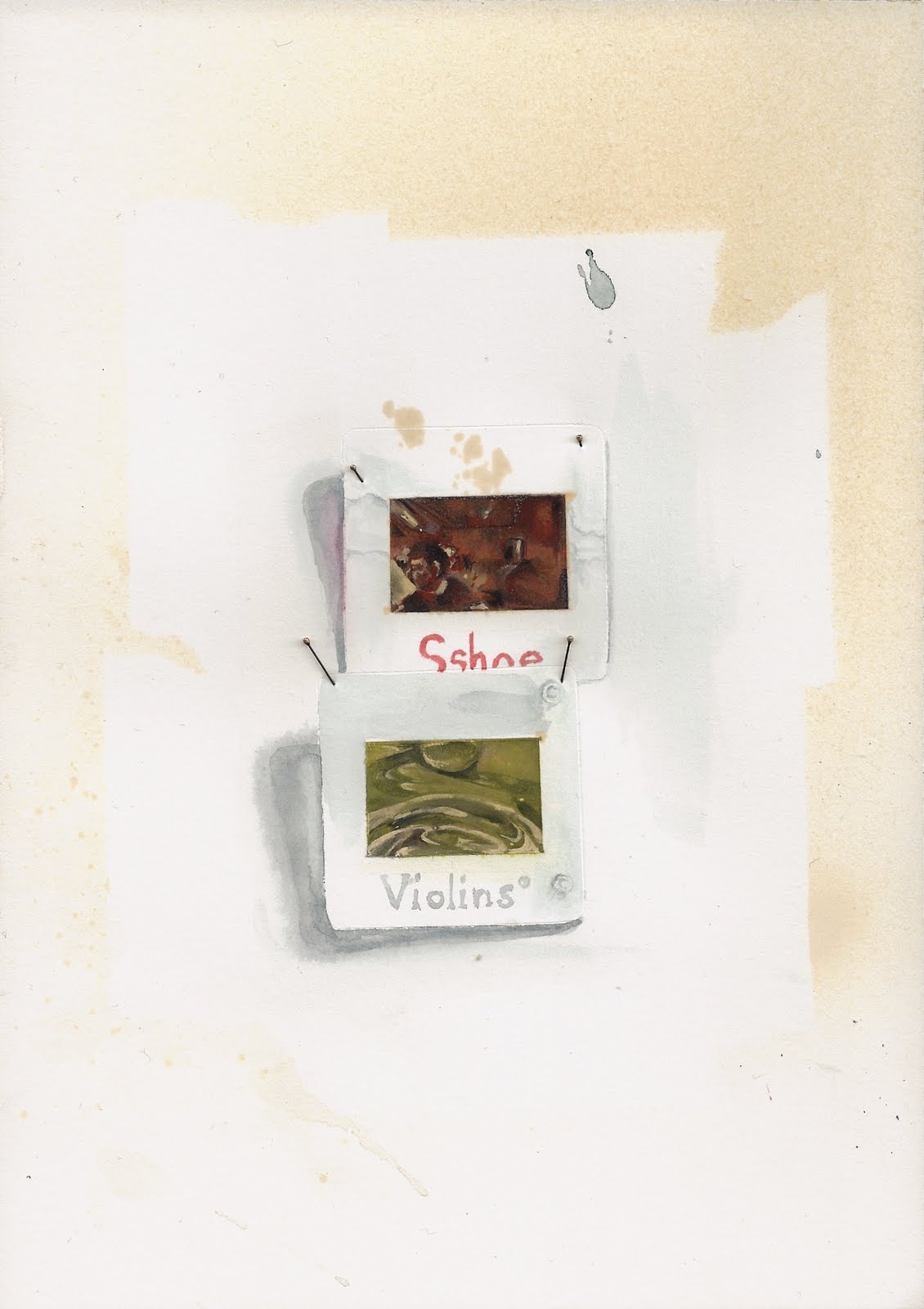
"Sshoe Violins"© 2004
Watercolor and Gesso on Paper


Have we not come to such an impasse in the modern world that we must love our enemies - or else? The chain reaction of evil - hate begetting hate, wars producing more wars - must be broken, or else we shall be plunged into the dark abyss of annihilation.
Martin Luther King, Jr.


This concludes Week Twenty Three of
"The God and The Universe Conversations".


All art and writing by Tom Schulz unless otherwise noted, or unless it is so cool
he will try to get away with claiming it as his own."The God and The Universe Conversations" are based on Tom's protracted reading of Process and Reality, by Alfred North Whitehead.

The important thing is this: to be able at any moment to
sacrifice what we are for what we could become.

Charles Du Bos


Tuesday, May 17, 2011

Movie Night at the Educational Center: "The Secret Life of Bees"


"The truth is, in order to heal we need to tell our stories and have them witnessed...The story itself becomes a vessel that holds us up, that sustains, that allows us to order our jumbled experiences into meaning."

Sue Monk Kidd
The Dance of the Dissident Daughter: A Woman's Journey from Christian Tradition to the Sacred Feminine


"The Secret Life of Bees: Reflections in a Cultural Mirror"
A Review by Tom Schulz


“A house divided against itself cannot stand.”
Abraham Lincoln

If The Secret Life of Bees is a story about making honey, then Huckleberry Finn is a guidebook to the Mississippi River. No, this is an epic tale of awakening and discovery. Of transformation and stultification. And love. Love that supports no single meaning as it shifts and morphs and takes root all of a once. This is a movie populated by diverse and complex characters, where the very character and unwritten laws of the United States of America plays a pivotal (and un-credited) role. Directed by Gina Prince-Bythewood in 2008, The Secret Life of Bees is based on the 2002 historical novel and New York Times bestseller by Sue Monk Kidd. It is a thoughtful adaptation of the novel: clear in its visual vernacular of the year 1964. The film’s use of color captures both the fecund density and lyrical luminescence of the Southern light. Prince-Blythwood allows us to understand that if light is both wave and particle, it is equally capable of harboring shadow as well as illumination.

Lily Owens (portrayed by a precocious and convincing Dakota Fanning) is haunted. Her burden is summarized in an opening voiceover when she says, "I killed my mother when I was four years old, that's what I knew about myself. She was all I wanted and I took her away. Nothing else much mattered." Constantly terrorized and belittled by her father T-Ray (a relentlessly ferocious Paul Bettany), Lily finds solace and validation in the company of the housekeeper, Rosaleen (Jennifer Hudson). Under the auspices of getting Lilly fitted for a training bra (a rite of passage indicating Lilly’s evolving transformation into maturity, and a subterfuge that would, of course exclude T-Ray), Rosaleen and Lily trek to town. Rosaleen’s intention is to register to vote, and she is accosted by a pack of feral rednecks. Under duress, Rosaleen sheds her cultural cloak of invisibility and stands for her human rights. Her reward is a severe beating. She is hospitalized for her “safety”. Lily is concerned that Rosaleen will be killed. A legitimate concern, given her understanding of male violence, and knowing – somehow – that there was no Atticus Finch to protect her Tom Robinson. Acting with more teenage passion than plan, she and Rosaleen escape their assumed fate and begin their search for sanctuary. Lily has instinctive reason to believe the grail of safety and discovery abides in Tiburon, South Carolina.


In Tiburon, Lily and Rosaleen find the Boatwright sisters – August, May, and June (played respectfully by Queen Latifah, Sophie Okenedo, and Alicia Keys). Each sister possesses a special access to the world. August is the matriarch, and decides to take in the fugitives. Rosaleen soon recognizes that, “They got they’re own special place, where the outside don’t come in.”
As the name Boatwright indicates, the three sisters construct a storm-worthy vessel of protection and love that affords Lily and Rosaleen the necessary craft to navigate towards self-actualization.


If my math is correct, the author Sue Monk Kidd was fourteen in 1964. Old enough to recognize the injustices that languished on small town street corners of the day and practiced their ill begotten sorcery of the night. And though the strength of love can provide strength in community, even Lily was aware that at any moment one could bring “the Outside in Here.”
During Lyndon B. Johnson’s term as John F. Kennedy’s Vice- President, racism became an increasingly important political issue. Vice- President Johnson expressed his understanding that something had to be done when he said, "The Negro fought in the war, and….he’s not gonna keep taking the shit we’re dishing out. We’re in a race with time. If we don’t act, we’re gonna have blood in the streets." As President, Johnson signed the Civil Rights Act of 1964, a bill that changed the face of America. It opened all public accommodations to all Americans regardless of race, color, religion or national origin. A Texan, Johnson was criticized for using the issue of race and rights for political gain. But Johnson himself claimed to be an idealist who dreamed of making America a "Great Society". Earlier in his career he stated that, "This country won’t have to worry about isms [communism and fascism] when it gives its people a decent, clean place to live and a job.”

Even as The Secret Life of Bees presents a riveting and compelling narrative of a time passed, it forces the viewer to consider the current state of this Country’s malaise. It brings forth the critical question and asks, “What is reflected in the mirror of this particular History, and how shall we respond to what we see?”


"It is the peculiar nature of the world to go on spinning no matter
what sort of heartbreak is happening."
Sue Monk Kidd, The Secret Life of Bees


Movie Night, 6:30 PM, May 20th at The Educational Center
http://educationalcenter.org/


Wednesday, May 11, 2011

"The God and The Universe Conversations". Week Twenty Two.

"The Sacrifice of Isaac"
Part Five

“Our duty, as men and women, is to proceed
as if limits to our ability did not exist.
We are collaborators in creation.”

Teilhard de Chardin


"Towards Sheryl's House - 7:05 (Study)"© 2011
Digital Print


15 The angel of the Lord called to Abraham a second time from heaven, 16and said, ‘By myself I have sworn, says the Lord: Because you have done this, and have not withheld your son, your only son, 17I will indeed bless you.....Genesis 22, The New Revised Standard Version, copyright 1989


"Approaching Newen, NC"© 1996
Acrylic on Canvas 4' X 8'

"where lamps are lit as symbols, not as facts"


FESTIVAL OF LIGHTS

We arrive too early at the Festival of Lights
where the tents are still erecting, the Ferris wheel
lies pitched against its axle, and the lanterns overhead
wait in ranks to be lit. I point you toward the Greek church
but you are willful as mercury, off the concrete walk
following your own low road across the grass
like a ball on a bad break, determined to bogey.
Your foot catches and you almost buckle
on the forked root of a droughtstruck tree,
but you run on, past a barricade of angels,
the crossed stone dolls of another generation,
over the lawn into darkness, away from me.

I find your shadow where the churchyard ends
at the edge of a fallow tobacco field
where the windings of raspberries and stronger grasses
rise up and stop you. Nothing here frightens you:
not night, climbing like moss in the trees,
or the truck beside you impounded in weeds,
hoarding lockjaw and bluebells in its clasped doors.
It is here you choose to play. I watch for weeds
with triplet leaves, for snakes sining the world
into waves of luck and danger, a covered ditch,
the small clay pots of budding hornets.
All we find is a box of Happy Meals
its yellow cardboard sogging in the leaves,
some half-ripe berries, a scrap of arrowhead
and a violet beetle that may or may not be dead
from harboring a virus I will read about
in next year's journals. It takes all I have
not to drive you away, but to stay and watch
as you inch your hands toward the thorny fruit
you covet. With such ease I could lift you up
to where you want to be, across this break
and into the wild garden, the forbidden field
that you cannot imagine you can be whole without,
where you would grow almighty, or not at all.

Son, we are here tonight to celebrate
what is neither light nor dark but both at once,
this margin we inhabit between eternities:
the one we think we know and struggle in
and the one that leads us on and seems to know us best,
like a car following behind us down the street
and forever offering to take us in,
its deft doors open, the strangers inside beckoning
to come and join them in that perfumed cabin.

Behind us, the hurdy-gurdy starts to swell
with children turning on the music rides;
their fathers lift a sledge to ring the bell,
they lift, and fail, and lift and try again;
their mothers clutch together in the halls
to speak small lies and taste the lamb for salt;
they drink retsina, watch the biscuits rise,
and set up tables as they talk about their faith
that still endures, although they bleed each month.
Come, turn back with me. Our place is there,
where lamps are lit as symbols, not as facts,
and every path lies twisted in unreason.

Son, turn back with me. This is the sacrifice
we make in terror every day.

Philip Bowman, The Museum of Childhood


"Story Time"© 2011
Digital Print


"we are here tonight to celebrate
what is neither light nor dark but both at once
"


“Novena for Sendai Series©”. Study #5.

Digital Print


From the Editor: Where the darkness defines the light, the light loses its timidity. It is here that blessings remain undiscovered until illuminated.

This concludes Week Twenty Two of
"The God and The Universe Conversations".


All art and writing by Tom Schulz unless otherwise noted, or unless it is so cool
he will try to get away with claiming it as his own."The God and The Universe Conversations" are based on Tom's protracted reading of Process and Reality, by Alfred North Whitehead.

The important thing is this: to be able at any moment to
sacrifice what we are for what we could become.

Charles Du Bos


Saturday, May 7, 2011

"The God and The Universe Conversations". Week Twenty One.


"The Sacrifice of Isaac"
Part Four

“It’s always been in between the things I thought I was doing that the real work has happened.”
William Kentridge


"Right"© 2008
Gesso, Marker, Acrylic on Canvas

14So Abraham called that place ‘The Lord will provide’; as it is said to this day, ‘On the mount of the Lord it shall be provided.' Genesis 22, The New Revised Standard Version, copyright 1989


"One Point: Perspective"© 2008
Graphite, Acrylic, Marker, Gauze on Canvas

From the Editor: I have a tendency to celebrate my creative energy when I feel its expression as powerful and exhilarating. I refer to these experiences as "Times of Flight". Maybe you know what I am talking about. I hope so. When I despair or wallow about in perceived failures, I abrogate responsibility and (most typically) look for something (or someone) to blame. In these moments I become blind to the source of plenty that surrounds me. This does not 'draw me nearer'. So I cannot be sacrificing - though it seems as if I am. Maybe you know what I'm talking about. Maybe not. The early translation into Greek of the Hebrew Jehovah-jireh gives the meaning as "The Lord hath seen." More contemporary translations render it "the Lord will provide", serving up a more literal meaning, kind of like, "the Lord will see to it". But right now, in this moment, I am going ask this question: High or low, ecstatic or bereft, panicked or at peace, is it enough to know that our lives and efforts are recognized? Are being 'seen'? Friend, if that is the case, then that in itself is Plenty. Maybe you know what I'm talking about.


"Morel Fabric"© 2008
Marker, Acrylic, Collage on Canvas

"If you cling to an idea as the inalterable truth,
then when the truth does come in person
and knock at your door,
you will not be able to open the door and accept it."

Udana Sutta


"L O V E"© 2008
Acrylic, Graphite, Gesso on Canvas


“to be nobody but yourself in a world which is doing its best, night and day, to make you everybody else means to fight the hardest battle which any human being can fight; and never stop fighting.”
e. e. cummings


This concludes Week Twenty One of
"The God and The Universe Conversations".


All art and writing by Tom Schulz unless otherwise noted, or unless it is so cool
he will try to get away with claiming it as his own."The God and The Universe Conversations" are based on Tom's protracted reading of Process and Reality, by Alfred North Whitehead.

The important thing is this: to be able at any moment to
sacrifice what we are for what we could become.

Charles Du Bos


Saturday, April 30, 2011

"The God and The Universe Conversations". Week Twenty.


"The Sacrifice of Isaac"

Part Three


For fear you will be alone
you do so many things
that aren’t you at all.

Richard Brautigan


Tom Schulz, "Red States, Blue States" © 2008
Gouache, House Paint, Gesso on paper mounted on canvas.


11But the angel of the Lord called to him from heaven, and said, ‘Abraham, Abraham!’ And he said, ‘Here I am.’ 12He said, ‘Do not lay your hand on the boy or do anything to him; for now I know that you fear God, since you have not withheld your son, your only son, from me.’ 13And Abraham looked up and saw a ram, caught in a thicket by its horns. Abraham went and took the ram and offered it up as a burnt-offering instead of his son. Genesis 22, The New Revised Standard Version, copyright 1989


Isaac Schulz, "EALL 271"©, 2003
House Paint, Spray Paint on Canvas.

From the Editor: I recently talked with a friend. She shared her story of a recent series of life decisions that have left her feeling (emotionally and fiscally) bankrupt. Her question to herself and to The Universe became both prayer and lament: "What was I thinking?". It made me think of Abraham with the knife to his beloved son's throat. It made me think of Jim Jones and Charles Manson. Susan Smith and Andrea Yates. And I wondered, why was it that Abraham required a mediating agency to stay his hand? Why was he so willing to act out of a concept of obedience? A concept that allowed his perceived directives to supersede his ability to properly judge the ramifications of his actions. Perhaps we should look at our interior Abrahams and ask what precious part of our selves are we are willing to sacrifice. Hannah Arrendt stated that, "The sad truth is that most evil is done by people who never make up their minds to be either good or evil." Let us not wait for intervention. Or mediation. Let us make up our minds. Let us make up our minds and hearts and interactions to be good. Stay your own hand, pilgrim.


Marc Chagall,
Sacrifice of Isaac, 1960-1965

“There is no beauty in sadness. No honor in suffering. No growth in fear. No relief in hate. It’s just a waste of perfectly good happiness.”
Katerina Stoykova-Klemer


“He learned to live with the truth.
Not to accept it, but to live with it.

It was like living with an elephant. His room was tiny, and every morning he had to
squeeze around the truth just to get to the bathroom.
To reach the armoire to get a pairof underpants
he had to crawl under the truth, praying it wouldn’t
choose that moment to sit on his face.”

Nicole Krauss, The History of Love


This concludes Week Twenty of
"The God and The Universe Conversations".


All art and writing by Tom Schulz unless otherwise noted, or unless it is so cool
he will try to get away with claiming it as his own."The God and The Universe Conversations" are based on Tom's protracted reading of Process and Reality, by Alfred North Whitehead.

The important thing is this: to be able at any moment to
sacrifice what we are for what we could become.

Charles Du Bos